Friday, 26 September 2014

STUDY ONLY AS ACURATE AS IT SOURCES,,= MEDIA AND NON EXPERTS NO CONFIRMATION

ANOTHER FOAMER FAIL, DOG IDENTIFICATION WAS NEVER DONE SO CONCLUSIONS ARE FLAWED ???? MEDICS ARE NOT BREED EXPERTS, POLICEMEN ARE NOT BREED EXPERTS, ANIMAL CONTROL OFFICERS ARE NOT DOG BREED EXPERTS, WITNESSES OFF THE STREET ARE NOT EXPERTS, AND VICTIMS AND FAMILY OF VICTIMS ARE NOT DOG BREED INDENTIFICATION EXPERTS!! THERE WAS NO LEGITIMATE CONFIRMATION OF DOG BREED IN ANY ATTACKS??

 2011 Apr;253(4):791-7. doi: 10.1097/SLA.0b013e318211cd68.

Mortality, mauling, and maiming by vicious dogs.

Abstract

OBJECTIVE:

Maiming and death due to dog bites are uncommon but preventable tragedies. We postulated that patients admitted to a level I trauma center with dog bites would have severe injuries and that the gravest injuries would be those caused by pit bulls.

DESIGN:

We reviewed the medical records of patients admitted to our level I trauma center with dog bites during a 15-year period. We determined the demographic characteristics of the patients, their outcomes, and the breed and characteristics of the dogs that caused the injuries.

RESULTS:

Our Trauma and Emergency Surgery Services treated 228 patients with dog bite injuries; for 82 of those patients, the breed of dog involved was recorded (29 were injured by pit bulls). Compared with attacks by other breeds of dogs, attacks by pit bulls were associated with a higher median Injury Severity Scale score (4 vs. 1; P = 0.002), a higher risk of an admission Glasgow Coma Scale score of 8 or lower (17.2% vs. 0%; P = 0.006), higher median hospital charges ($10,500 vs. $7200; P = 0.003), and a higher risk of death (10.3% vs. 0%; P = 0.041).

CONCLUSIONS:

Attacks by pit bulls are associated with higher morbidity rates, higher hospital charges, and a higher risk of death than are attacks by other breeds of dogs. Strict regulation of pit bulls may substantially reduce the US mortality rates related to dog bites.
PMID:
 
21475022
 
[PubMed - indexed for MEDLINE]

Many practical alternatives to breed-specific ordinances exist and hold promise for prevention of dog bites.

 2000 Sep 15;217(6):836-40.

Breeds of dogs involved in fatal human attacks in the United States between 1979 and 1998.

Abstract

OBJECTIVE:

To summarize breeds of dogs involved in fatal human attacks during a 20-year period and to assess policy implications.

ANIMALS:

Dogs for which breed was reported involved in attacks on humans between 1979 and 1998 that resulted in human dog bite-related fatalities (DBRF).

PROCEDURE:

Data for human DBRF identified previously for the period of 1979 through 1996 were combined with human DBRF newly identified for 1997 and 1998. Human DBRF were identified by searching news accounts and by use of The Humane Society of the United States' registry databank.

RESULTS:

During 1997 and 1998, at least 27 people died of dog bite attacks (18 in 1997 and 9 in 1998). At least 25 breeds of dogs have been involved in 238 human DBRF during the past 20 years. Pit bull-type dogs and Rottweilers were involved in more than half of these deaths. Of 227 reports with relevant data, 55 (24%) human deaths involved unrestrained dogs off their owners' property, 133 (58%) involved unrestrained dogs on their owners' property, 38 (17%) involved restrained dogs on their owners' property, and 1 (< 1%) involved a restrained dog off its owner's property.

CONCLUSIONS:

Although fatal attacks on humans appear to be a breed-specific problem (pit bull-type dogs and Rottweilers), other breeds may bite and cause fatalities at higher rates. Because of difficulties inherent in determining a dog's breed with certainty, enforcement of breed-specific ordinances raises constitutional and practical issues. Fatal attacks represent a small proportion of dog bite injuries to humans and, therefore, should not be the primary factor driving public policy concerning dangerous dogs. Many practical alternatives to breed-specific ordinances exist and hold promise for prevention of dog bites.
PMID:
 
10997153
 
[PubMed - indexed for MEDLINE]

FOAMER FAIL THIS REPORT SAYS "VICIOUS" NOT PITBULLS???

FOAMER FAIL THEY CONSISTENTLY PROMOTE THIS STUDYING AGAINST PITBULLS WHEREAS PITBULLS ARE NOT EVEN MENTIONED, TYPICAL FOAMERS ALL NOISE NO CONTENT??


J Interpers Violence. 2006 Dec;21(12):1616-34.

Ownership of high-risk ("vicious") dogs as a marker for deviant behaviors: implications for risk assessment.

Author information

  • 1Cincinnati Children's Hospital Medical Center, Ohio, USA.

Abstract

This study examined the association between ownership of high-risk ("vicious") dogs and the presence of deviant behaviors in the owners as indicated by court convictions. We also explored whether two characteristics of dog ownership (abiding licensing laws and choice of breed) could be useful areas of inquiry when assessing risk status in settings where children are present. Our matched sample consisted of 355 owners of either licensed or cited dogs that represented high or low-risk breeds. Categories of criminal convictions examined were aggressive crimes, drugs, alcohol, domestic violence, crimes involving children, firearm convictions, and major and minor traffic citations. Owners of cited high-risk ("vicious") dogs had significantly more criminal convictions than owners of licensed low-risk dogs. Findings suggest that the ownership of a high-risk ("vicious") dog can be a significant marker for general deviance and should be an element considered when assessing risk for child endangerment.
PMID:
 
17065657
 
[PubMed - indexed for MEDLINE]

Thursday, 25 September 2014

MISTAKEN IDENTITY Many shelter dogs mislabeled ‘pit bulls’ DNA analysis shows guesses often subjective

MISTAKEN IDENTITY

Many shelter dogs mislabeled ‘pit bulls’

DNA analysis shows guesses often subjective

BY TANYA IRWIN
BLADE STAFF WRITER
Lucas is lucky to be alive.
The dog, owned by Laurie and George Hughes of Rossford, was one of the first "pit bull" puppies spared by the Lucas County dog warden in January, 2010, after the county commissioners changed a long-standing policy under which all "pit bulls," no matter their age or temperament, were automatically destroyed.
The irony is that Lucas, who was transferred to the Toledo Area Humane Society, isn't a "pit bull."
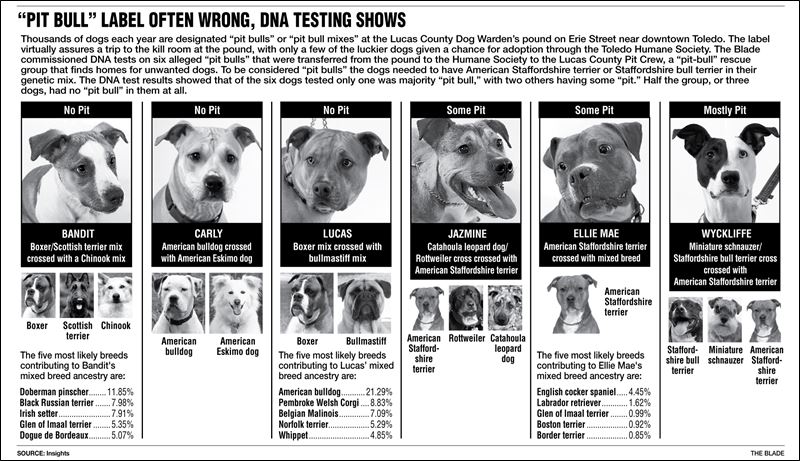
According to a DNA test, Lucas is predominantly a boxer/bullmastiff mix, with a few other mixed breeds thrown in. But the dog doesn't have any American Staffordshire terrier or Staffordshire bull terrier in his lineage, according to a Mars Veterinary Wisdom Panel Insights DNA test.
"We really don't care what breed he is, he's a good dog and we love him," said Mr. Hughes, who with his wife adopted Lucas from the humane society. "I think it's awful what people say about 'pit bulls' or dogs that look like 'pit bulls.' It's like racism, except against dogs."
Lucas isn't alone. Many dogs are mislabeled as "pit bulls" because they might have a certain look -- such as a large head or broad chest.
The Blade purchased the DNA-gathering kits from the Mars Veterinary company and conducted the tests on six dogs that were originally labeled as "pit bulls" by the Lucas County dog warden.
The test consists of two swabs with wire bristles that are scraped on the inside of the dog's cheek to remove skin cells. The swabs were placed in protective plastic casings and mailed to the laboratory for analysis, which took three to four weeks.
Only one of the six tested dogs was predominantly American Staffordshire terrier and Staffordshire bull terrier, the two recognized breeds labeled as "pit bulls." Two others had some "pit," and three dogs had no "pit bull" breed in them at all.
Besides Lucas, which had no "pit" breed in his genetic makeup, there were two other dogs with no "pit":
Carly: American bulldog and American Eskimo dog.
Bandit: Boxer, Scottish terrier, Chinook, Doberman pinscher, black Russian terrier, Irish setter, Glen of Imaal terrier, and dogue de Bordeaux.
Two of the dogs had some "pit" in them:
Ellie Mae: American Staffordshire terrier, English cocker spaniel, Labrador retriever, Glen of Imaal terrier, Boston terrier, and border terrier.
Jazmine: Catahoula leopard dog, Rottweiler, and American Staffordshire terrier.
Only one of the six dogs' DNA tested by The Blade was majority "pit bull":
Wyckliffe: Miniature schnauzer, Staffordshire bull terrier, and American Staffordshire terrier.

THE BLADEEnlarge | Buy This Photo
Labeling canines
Determining a dog's breed can be subjective. Yet that can determine whether a dog lives or dies in Toledo and Lucas County.
The concept has been researched before. Dr. Victoria Voith and colleagues from Western University of Health Sciences in Pomona, Calif., surveyed animal adoption agency personnel, asking them to name the breed or breeds of mixed-breed dogs whose origins they did not know and then compared their guesses to DNA analysis of the same dogs.
Her work concluded that there is little correlation between dog adoption agencies' identification of probable breed composition with the identification of breeds by DNA analysis.
Former Lucas County Dog Warden Tom Skeldon said that when he was in the position two years ago, he didn't think the DNA tests were accurate.
"When I left the field, the DNA situation was something that was being put up by 'pit bull' advocates to show that you couldn't prove and animal was a 'pit bull,' " he said. "There's a couple of flaws in that. 'Pit bulls' aren't a breed, they're a type. So you are trying to find genetic evidence of a type as opposed to a breed. We won those cases in court."
Dr. Angela Hughes, a veterinarian and the veterinary genetics research manager at Mars Veterinary, said the reliability of the tests the company sells has increased over the past four years. Currently the swab-based DNA test has an accuracy rating of 80 to 85 percent, depending on how good a sample is provided.
Dr. Hughes checked the samples that The Blade had submitted. The swabs had collected a good amount of DNA, which drives up the reliability of the tests, she said. With samples that don't have as much DNA to work with, results may contain a breed that isn't in the dog or may miss breed, but the entire test is not wrong.
Killing continues
Mr. Skeldon, forced into retirement in part because of the furor over his high kill rate and his insistence that all dogs he deemed "pit bulls" must be killed, remains unrepentant about killing "pit bulls."
As warden he killed "pit bulls" even if they were gentle dogs that could have been adopted. He also insisted on killing all puppies he deemed to be "pit bulls."
It's impossible to know how many dogs Mr. Skeldon killed claiming they were "pit bulls" when they weren't, but based on the kill rate during his more than 20 years as warden, the fact that close to half the dogs at the pound traditionally have been labeled "pit bulls," and the DNA tests The Blade performed, easily thousands of dogs could have been killed because they were mislabeled "pit bull."
Mr. Skeldon stands by his visual observations, saying 98 percent of the dogs he deemed to be "pit bulls" were that and deserved to die to protect the public.
The Lucas County dog warden's office continues to kill dogs because it is "at capacity for 'pit bull-type' dogs." Dog Warden Julie Lyle has yet to begin adopting out "pit bulls" directly to the public instead relying on the Toledo Area Humane Society and rescue groups such as the Lucas County Pit Crew to take them.
At issue has been the state's dangerous dog law, which until it officially changes May 21, still labels all "pit bulls" as dangerous, vicious dogs, despite their actual behavior. Ms. Lyle will not adopt out "pit bull"-type dogs as long as they are considered vicious.
However, the humane society has adopted out nonvicious "pit bulls" since April, 2010, directly adopting out 79 itself while sending 75 on to rescues such as the Lucas County Pit Crew.
'Shelter dogs'
As a way to combat the issue, Dr. Amy Marder, director for the Center for Shelter Dogs, has proposed that dogs adopted from shelters in the United States simply be identified as "American shelter dogs."
Jean Keating, co-founder of the Lucas County Pit Crew, a rescue group that supports responsible guardians of "pit bull"-type dogs through education, advocacy, training assistance, spay/neuter promotion, and adoption, agrees with that approach.
"When it comes down to deciding issues of life and death, if we are basing that on a decision about appearance, then we are really going down the wrong path," Ms. Keating said. "If breed experts are telling us that they are not comfortable identifying mixed breeds, then why do any of us think we can do it?"
Identifying breeds
One shelter, the North Shore Animal League in Port Washington, N.Y., has done away with the label "pit bull," instead referring to dogs with that look as "terrier mixes," because all of the breeds commonly given the "pit bull" moniker are in the terrier group.
Ms. Lyle, who identifies 40 percent of the dogs the pound takes in as "pit bulls," said she has a problem with that approach because she thinks it is deceptive to the public.
"When people think of terriers, they think of small, cuddly dogs, not large dogs," Ms. Lyle said.
She said that besides herself, others in the facility such as the deputy dog wardens or the office staff, are the ones who designate the breeds of dogs that are impounded. Owners are asked to identify the breed of a dog they are surrendering, and the pound usually defers to them, unless the breed they name is obviously incorrect.
"Puppies are a lot harder to determine," she said. Two of the dogs The Blade conducted DNA tests on were puppies when they were identified as "pit bulls" by the dog warden's office.
Ms. Lyle said she thought she and her coworkers had done pretty well in guessing the breeds of dogs they designated as "pit bills" but was not surprised that they had gotten some wrong. She said she doesn't see any reason for the pound to change how it identifies a dog's breed.
Two of the dogs tested were under a year old when the pound labeled them "pit bulls."
Ms. Lyle said guessing the breed of a puppy is a lot more difficult than that of an adult dog. As for the adults she got wrong, she stood by her original assessment, but acknowledged that guessing breeds is very subjective. "We do the best we can," she said. "And we're not afraid to ask for a second opinion [of another staff member] if we are not sure."
The Toledo Area Humane Society defers to the dog warden on naming the breeds of dogs that are transferred to the shelter from the pound -- including 91 "pit bulls" in 2011. "If we change the breed designation they put on a dog either from or to 'pit bull,' we make sure that is OK with [the dog warden,]" said John Dinon, executive director of the humane society.
The humane society has discussed changing how it labels dogs, he said. "We have discussed this, not so much in the context of 'pit bulls' but just to make sure we are not misrepresenting," he said. "For example, if we call something a Lab mix, we don't want an adopter to be disappointed if it ends up not loving water."
One suggestion that was made was calling all dogs at the shelter "American" mixes.
"I think we are going to continue to use breed and breed mix labels but tell adopters that breed designations are based on our assessment of physical appearance and reports from previous owners only," Mr. Dinon said.
The humane society is aware of the need to educate the public about "pit bull" facts and fallacies, he said. The feature article in the humane society's next newsletter will focus on "pit bulls."
The story is about the law change and also about how the new law does not address some "pit bull issues" such as overpopulation, the fact that some criminals use them for intimidation, which can lead to stigma, that they are the dogs that are most often victims of cruelty, and that they are the preferred dogs of dog fighters.
"We certainly have been advocates to judge dogs by behavior and not breed, and our education programs include some breed identification games, to show people how often they are wrong," Mr. Dinon said.
Contact Tanya Irwin at: tirwin@theblade.com or 419-724-6066.

Read more at http://www.toledoblade.com/local/2012/03/18/Many-shelter-dogs-mislabeled-pit-bulls.html#vhGeyDHu2xi4rbPM.99

Incoherent definitions confound attempts to label dogs as “pit bulls”

Most animal shelters continue to assign breed descriptors to dogs whose origin they do not know[1], even though current university research has shown that breed identification based on visual inspection correlates poorly with DNA breed signature, and that observers will disagree with each other when examining the same dog. These difficulties are only compounded when the descriptor itself is subject to different interpretations.
A study by researchers in the US and UK examines the question of whether animal shelter workers in the two countries could agree on “what constitutes a pit bull terrier.”[2] Perhaps the most interesting observation to be made here is the apparent confusion on the part of both the researchers and the respondents regarding what they meant by the term “pit bull” and how they struggled to relate it to any concept of breed.
Subjects were asked to look at photos of 20 dogs, assigning a “primary” breed label to each and explaining how they came to this conclusion.[3] They then went back through the photos and decided which dogs they considered to be “pit bulls.” Finally, they were given a list of what the authors described as “bull breed” and “Mastiff breed” names and asked which they considered to fall within a category they would call “pit bulls.”
We now have well duplicated findings that demonstrate the lack of agreement even among animal professionals with regard to visual breed identification.[4][5],[6] So it is not surprising that the animal shelter workers surveyed by Dr. Hoffman and her colleagues did not agree on which dogs they assigned specific breeds to or which they considered to be “pit bulls”. They did not agree either within or between the two countries surveyed. The authors rightly concluded that their results “bring into question the validity of determining breed identity based on appearance,” and “highlight some issues regarding the practical utility of BSL.”
Using “pit bull” and “pit bull type” apparently interchangeably, the authors did not offer a definition of either term, but rather left the definition to the “intuition and prior experience” of the respondents.[7] This is not a fault of the study methodology, but simply a reflection of the fact that there is no generally accepted definition of any of these terms.
“A breed,” according to the seminal work on the topic completed more than 50 years ago, “is not defined by conformity to type, but by common ancestry and absence of outbreeding.”[8] The reason that Scott and Fuller specifically excluded “conformity to type,” i.e., morphology, is that they understood that genetic relatedness cannot be inferred from physical resemblance. Membership in a breed is a matter of close genetic relatedness, generally documented through pedigrees, and recognizes no dogs with ancestors from outside the group for a specified number of generations.
Misunderstanding the meaning of breed led to the first level of confusion in this study. When asked to identify the photos according to breeds, respondents offered both descriptors like Staffordshire Bull Terrier, Boxer, American Bulldog, Labrador Retriever, etc. which are actual breeds, and others, such as “pit bull,” and “terrier,” which are not breeds according to any major national registry that documents pedigrees and limits registration to closed gene pools.
Survey participants were also stumped by the question of which breeds to classify as “pit bull type.” This too is understandable, as no such category exists. Breeds of dogs are categorized by the major breed organizations by “groups,” largely according to folklore regarding the traditional work of the breeds with the group. Aptitude for such historical behaviors is no longer expressed among such breed groups, however.[9] ”Terrier,” for example, is one such group in the major breed club associations of both the US and the UK. “Pit bull,” on the other hand, is not.
“Pit bull” is not a breed. It is a social construct, the perception of an individual or group, an idea that is invented and ‘constructed’ through cultural or social practice.
“Pit bull” exists because people agree to behave as if it does, even though they can’t tell you exactly what they mean by the term. In past litigation in Ohio, the county dog warden summed it up nicely when he admitted that there really was no way to tell whether or not a dog was a “pit bull,” and that the determination was a matter of subjective opinion.[10] Differences of definition, lack of agreement between visual identifications and DNA breed signatures, disagreement among observers looking at the same dog, and poor understanding of the meaning of breed and genetic relatedness, mean that an individual’s belief as to whether or not a dog is a “pit bull” may have no scientific significance whatsoever, but severe consequences with respect to the welfare of an individual dog.


[1] Though some animal shelters have moved away from the practice.
[2]  Hoffman, C.L., Harrison, N., Wolff, L., & Westgarth, C. (2014). Is That Dog A Pit Bull? A Cross-Country Comparison of Perceptions of Shelter Workers Regarding Breed Identification. Journal of Applied Animal Welfare Science. Available at:  http://www.tandfonline.com/doi/full/10.1080/10888705.2014.895904#.U2J9UPldW-c
[3] The authors state that the photos selected include “11 bull breeds or bull breed mixes, 2 each being highly probable pit bull terrier examples,” although they make no mention of how this probability was determined.
[4] Voith, V.L., Ingram, E., Mitsouras, K., & Irizarry, K. (2009). Comparison of Adoption Agency Identification and DNA Breed Identification of Dogs. Journal of Applied Animal Welfare Science. 12(3). 253-262.
[5] Voith, V.L, Trevejo, R., Dowling-Guyer, S., Chadik, C., Marder, A., Johnson, V., & Irizarry, K. (2013). Comparison of Visual and DNA Breed Identification of Dogs and Inter-Observer Reliability. American Journal of Sociological Research, 3(2), 17-29. Available at: http://article.sapub.org/10.5923.j.sociology.20130302.02.html
[6] Levy, J.K. (2012). DNA and Survey Results: What Kind of a Dog Is That? Retrieved from: http://sheltermedicine.vetmed.ufl.edu/library/research-studies/current-studies/dog-breeds/dna-results/
[7] The authors  also use the term “bull breed,” seeming to imply that this is a term of art in the field, but nowhere offer a definition.
[8] Scott, J. P., & Fuller, J. L. (1965). Genetics and the Social Behavior of the Dog. (pp.38). Chicago, IL: Univ. of Chicago Press
[9] Svartberg, K. (2006) Breed-typical behaviour in dogs—Historical remnants or recent constructs? Applied Animal Behaviour Science. 96(3), 293–313.
[10] Toledo v. Tellings, Lucas App. L-04-1224, 2006-Ohio-975.

Dogsbite.org Dogbite "Statistics" - The Fox Guarding the Henhouse?

Dogsbite.org Dogbite "Statistics" - The Fox Guarding the Henhouse?

Dogsbite.org A "Victim" Advocacy Group

Special Interest Adocacy Groups Statistics Objective? 

Dogsbite.org is a "victim" advocacy group founded by Colleen Lynn.  Its goal is to advocate on behalf of Breed Specific Legislation by lobbying legislatorsaggressive internet advocacy, and most importantly, creating dog bite statistics that meet their agenda. PBLN previously highlighted the overall lack of objectivity at dogsbite.org here. This article will discuss why dogsbite.org statistics lack scientific basis, and how mainstream organizations have discredited attempts to create breed specific dog bite data.  Relying on dogsbite.org bite statistics, is like allowing the fox to guard the henhouse.

CDC Says Breed Dog Bite Statistics Cannot Be Measured

Since the late 1990's the Center for Disease Control ceased tracking dog bites by breed/type, as it was their determination that such studies do "not identify specific breeds that are most likely to bite or kill, and thus is not appropriate for policy making decisions related to the topic....There is currently no accurate way to identify the number of dogs of a particular breed, and consequently no measure to determine which breeds are likely to bite or kill." Makes a little sense; if you don't know the total number of dogs in a breed, you can't create a percentage of the number of dog bites per breed.
So where are recent statistics generated from that are often published in news stories today? More importantly, how are they obtained? Is there any science behind the methodology of compiling these bite statistics by breed/type?


Who is Merritt Clifton And What Are His Credentials?

Most news stories obtain their Pro-BSL statistics from dogsbite.org. As noted above, Colleen Lynn started this anti-pitbull blog in 2007 as a result of what she decribed as a vicious pit bull attack.  PBLN has previously reported on the evolution of this preventable accident into the myth of vicious pit bull attack.  Initially, Lynn compiled her dog bite data from a study done by Merritt Clifton. Nobody has any idea what his raw data was, and none of his statistics are consistent with what independent peer reviewed research shows. He has no qualifications to do scientific research into dog behavior. Out of all the dog bite reports and information available in 2008, including the CDC and AVMA, Lynn chose Merritt Clifton's self published unscientific and uncredentialed report? Yes. It is the only report that agrees with the agenda of DBO.

DBO Fatal Dog Attack List Number Conflicts With CDC

Lynn has complied a Fatal Dog Attack list which includes 130 fatal dog attacks in the United States between 1900 - 2004. The problem with this list?  The CDC shows 300 human dog fatalities between 1979 - 1996. Thus the 100 year DBO list has less than half of the total number of bites than the CDC 17 year list.  Which list comes from a more objective source?

Identification of A Pit Bulls In Attacks Misrepresented

Lynn admits she has no expertise in dog behavior, identification, or dog bites. She is simply a web designer. So how does she decide what dog to put in the pit bull category? As many as possible?
PBLN has already exposed the Philadelphia case where news sources unanimously agreed they had initially misrepresented the breed involved in a fatal attack: it was not a pit bull but a Cane Corso. DBO's response? The ASPCA conspired to change the breed to Cane Corso.  Did this attack end up as a fatal pit bull attack in the statistics?
This is not the only case of misrepresenting the breed of dog involved in an attack.  In looking at DBO's historical attack list linked to actual media stories, one can quickly find stories that list the breed of dog as English Bull Dog, Boxer, or Boxer mix. Others fail to list the breed of dog at all, other than to identify it as a mixed breed.  Yet all of them are classified under the pit bull breed.
There are numerous examples of editorialization by Lynn when the breed of dog does not support her agenda. "It couldn't be more clear that Harrison is dealing with a pit bull owner and his dog" after a Hyannis ME resident reported he was bitten by a black lab.
In another story, Lynn reports a 2 year old child was air-lifted after a pit bull attack stating, "Pit bulls were selectively bred to attack; they do not need a reason." Yet the child was attacked by shepherd mix dog, not a pit bull.  

Historical List Mistaken or Intentionally Slanted?

PBLN made a  cursory effort to confirm the information contained in the "historical list." There were errors. Were they simple mistakes or an intentional slanting of the facts to support an agenda?
  • Court documents proved that an attack on an Illinois jogger in 2003 did not involve a pit bull dog;
     
  • A New Jersey resident did not die as a result of a dog attack according to a medical examiner's report and the dogs who were initially suspected of killing the resident were returned to their owner;
     
  • A 2001 account of a pit bull actually involved English Bulldogs according to a report from Animal Care and control;
     
  • A young victim that DBO says was killed in a pit bull attack in 2001 actually strangled by the tether of the dog, not the dog itself;
     
  • A Florida case from 2000 involving a toddler is on Lynn's list. According to the Alachua County Sheriff incident report obtained by PBLN, "the dog which bit the victim, a Labrador/mastiff/rottweiller mixed breed name RED, was in fact NOT a pit bull."
     
  • A case of a young child in California involving an unchained Rottweiler was incorporated by Lynn on her list based on Merritt Clifton's report;
     
  • A fatality for SC was listed by DBO as a pit bull. In fact, a report issued by the Fairfield County Sheriff's office, the Clemson Veterinary Diagnostic Center conducted a necropsy on the dog and clearly described it as a mixed breed;
     
  • Alexandria Reeves, a 4 day old infant, is on the list as the victim of a fatal dog attack. However, the San Jose Mercury News and Houston Chronicle Archives stated the victim was treated for cuts and bruises at a nearby hospital and released, according to Lt. Robert Armstrong.
     
  • Let's not forget the Cane Corso classified as a pit bull in conspiracy with the ASPCA discussed above.
In all, more than 17 cases were confirmed not be be a pit bull or inconclusive as the breed or type of dog.  In one case the victim did not die from the dog attack, and in one instance, the attack was not related to the dog at all.


Conclusion: If The CDC Can't Do-Neither Can DBO

PBLN's investigation was not intended to be exhaustive or complete.  It was an effort to illustrate that major problems exist in the methodology of DBO regarding correctly identifying the dog breed involved and the cause of the incident. 
Further, the discrepancy between the CDC report of the total number of incidents compared to the DBO list, shows a major shortcoming in the reliablity of the list. The CDC is a major governmental agency with no interest in the outcome. How is it that DBO can scientifically and reliably state the number percentage of pit bull related attacks, when nobody knows how many pitbulls or the total number of any breed of dog? 
The CDC has concluded it can't be done.  Not even worth tracking.
If the Center for Disease Control can't do it, what special expertise does Colleen Lynn and DBO have that the CDC doesn't? How can they scientifically and reliably compete with the resources of the CDC?
When DBO adequately answers this question, they might make a step toward credibility.